
Nigeria Agricultural Quarantine Service (NAQS) Recruitment 2026: Comprehensive Portal Guide

Complete guide to the 2026 Nigeria Agricultural Quarantine Service (NAQS) recruitment. Explore open positions, eligibility criteria, CONRAISS/CONMESS salary scales, application portal, and exam tips. Portal is now accessible for registration
Nigeria Agricultural Quarantine Service (NAQS) Recruitment 2026: mPortal Guide, Positions, Salary Structure & Application Process
The Nigeria Agricultural Quarantine Service (NAQS) has officially announced its 2026 recruitment exercise. As a paramount regulatory agency operating under the Federal Ministry of Agriculture and Food Security, NAQS plays a critical statutory role in protecting Nigeria’s agricultural economy, biodiversity, and public health.
Read Also: Nigeria Customs Service Final Recruitment List 2026: Essential Next Steps for ASC II Candidates
If you aspire to build a stable and impactful public service career within Nigeria’s agricultural sector, this comprehensive recruitment guide provides everything you need to know. From job roles and statutory requirements to salary scales, selection schedules, and step-by-step application procedures, this article covers all details to ensure your application stands out.
About the Nigeria Agricultural Quarantine Service (NAQS)
Established to enforce Sanitary and Phytosanitary (SPS) measures, the Nigeria Agricultural Quarantine Service (NAQS) is mandated to prevent the introduction, establishment, and spread of foreign (exotic) pests, plant diseases, animal infections, and contaminants affecting agricultural and aquatic resources.
JOIN WHATSAPP GROUP FOR UPDATES
NAQS operates at all major entry and exit points across Nigeria—including international airports, seaports, land borders, and post offices. By monitoring and inspecting agricultural imports and exports, NAQS ensures that:
- Agricultural Trade is Safe: Exported commodities meet international standards, preventing trade bans and boosting non-oil export revenue.
- Local Ecosystems are Protected: Invasive species, destructive agricultural pests, and contagions are kept outside Nigeria’s borders.
- Public Health is Safeguarded: Zoonotic diseases (diseases transmissible from animals to humans) and contaminated food items are intercepted before entering domestic markets.
Joining NAQS means taking on a vital paramilitary-style regulatory mandate that combines field inspections, scientific testing, legal enforcement, and border security.
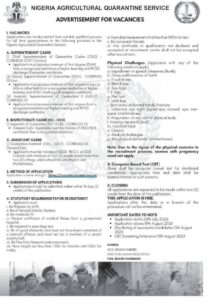
Detailed Overview of Vacant Positions & Job Cadres
For the 2026 recruitment exercise, NAQS is recruiting across multiple cadres ranging from entry-level high school certificate holders to specialized medical and legal professionals.
1. Chief Superintendent of Quarantine Cadre (CSQ) – Veterinary Doctors
- Job Field: Medical / Healthcare / Veterinary Services
- Job Type: Full Time
- Location: Nationwide (Nigeria)
- Minimum Qualification: First Degree in Veterinary Medicine (Doctor of Veterinary Medicine – DVM) from a recognized institution.
- Additional Requirement: Must possess a valid NYSC Discharge Certificate or Exemption Certificate.
- Key Responsibilities:
- Directing veterinary quarantine inspections at ports of entry and exit.
- Overseeing health clearance protocols for imported and exported live animals and animal products.
- Performing epidemiological surveillance and laboratory diagnostics for exotic animal diseases.
- Managing animal holding facilities and quarantine isolation quarters.
2. Deputy Superintendent of Quarantine (DSO) – Law
- Job Field: Legal and Regulatory
- Job Type: Full Time
- Location: Nationwide (Nigeria)
- Minimum Qualification: Bachelor’s Degree in Law (LL.B / BL) or a Master’s Degree (M.Sc/MA) in a related discipline from a recognized university.
- Additional Requirement: Must possess a valid NYSC Discharge Certificate or Exemption Certificate.
- Key Responsibilities:
- Drafting legal frameworks, regulatory guidelines, and quarantine operational protocols.
- Managing legal disputes, prosecutions, and enforcement actions against quarantine regulation violators.
- Advising the agency on international trade treaties, SPS agreements, and biosecurity laws.
- Overseeing administrative hearings and regulatory compliance checks across duty posts.
GET NAQS Recruitment CBT Past Questions &; Answers — 2026 Edition
3. Assistant Superintendent of Quarantine (ASQ)
- Job Field: Project, Program Management & Operations
- Job Type: Full Time
- Location: Nationwide (Nigeria)
- Minimum Qualification: First Degree (B.Sc / B.Tech / HND) from an accredited higher institution.
- Additional Requirement: Must possess a valid NYSC Discharge Certificate or Exemption Certificate.
- Key Responsibilities:
- Executing routine quarantine operational programs across designated border stations and international terminals.
- Conducting risk assessments on incoming plant materials, seeds, and agricultural produce.
- Assisting higher officers in monitoring agricultural supply chain biosecurity compliance.
- Documenting quarantine certification processes for exporters and importers.
4. Inspector of Quarantine
- Job Field: Administration / Facilities / Field Duty
- Job Type: Full Time
- Location: Nationwide (Nigeria)
- Minimum Qualification: Ordinary National Diploma (OND) or Nigeria Certificate in Education (NCE) from a recognized institution.
- Key Responsibilities:
- Performing primary physical inspections of baggage, cargo, and transport vessels at entry points.
- Collecting biological samples for laboratory testing and analysis.
- Enforcing quarantine isolation orders and cargo treatment procedures (e.g., fumigation oversight).
- Keeping operational logs and inspection register records.
5. Quarantine Assistant
- Job Field: Administration / Support Services
- Job Type: Full Time
- Location: Nationwide (Nigeria)
- Minimum Qualification: Senior Secondary Certificate Examination (SSCE), NECO, or GCE O/Level with a minimum of five (5) credits including English Language and Mathematics in not more than two (2) sittings.
- Key Responsibilities:
- Providing administrative, clerical, and operational support to field officers.
- Assisting in physical checks of agricultural freight and passenger luggage.
- Maintaining office files, duty logs, and customer service desks at quarantine checkpoints.
Mandatory Statutory & Eligibility Requirements
To maintain high professional standards and meet the physical demands of field enforcement, all applicants must meet the following mandatory requirements set by the Federal Civil Service Commission and NAQS leadership:
General Requirements
- Citizenship: Must be a Nigerian citizen by birth.
- National Identification: Must possess a valid National Identity Number (NIN).
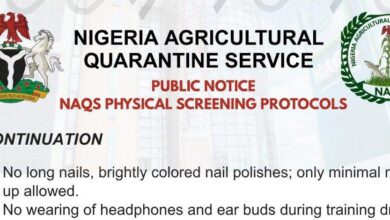
- Medical Fitness: Must be certified medically fit by a recognized government hospital. Shortlisted candidates will undergo mandatory drug testing and physical screenings.
- Moral Integrity: Must be of good character, must not have been convicted of any criminal offense, and must not belong to any secret society, cult, or unlawful organization.
- Financial Standing: Must be free from financial embarrassment or bankruptcy.
- Digital Literacy: Candidates must be computer literate, as the screening and modern work processes rely on digital tools.
Physical & Biological Criteria
Because NAQS is a field-enforcement agency, operational staff must satisfy baseline physical measurements:
-
- Height: Minimum of 1.65 meters for male candidates; minimum of 1.55 meters for female candidates.
- Chest Measurement: Minimum chest expansion of 0.87 meters for male candidates.
Important Qualification Policy: Any academic certificate or professional qualification not declared and accepted at the initial recruitment center will not be accepted or considered for promotion later in service.
Medical & Physical Exclusions
Due to the demanding physical nature of field enforcement, border patrols, and port inspections, candidates with the following conditions need not apply:
-
-
- Impediments in speech (stammering or inability to speak clearly)
- Gross malformation of teeth or jaw structure
- Limb deformities (Knock knees, Bow legs, K-legs, Flat feet, or Bent arms)
- History of fractures resulting in physical deformity or impaired mobility
- Visual impairments (Squint eyes, crossed eyes, one-eyed conditions, or total blindness)
- Hearing impairment (deafness or partial deafness)
- Hunched back or severe spinal deformities
- Obesity or severe cardiovascular/metabolic challenges
- Pregnancy (pregnant female candidates are exempted due to physical screening rigors)
-
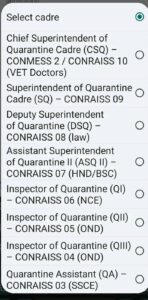
NAQS Salary Structure & Grade Levels
Remuneration at the Nigeria Agricultural Quarantine Service follows standard Federal Civil Service salary structures for allied research and medical agencies.
Officers in professional cadres are placed on the Consolidated Research and Allied Institutions Salary Structure (CONRAISS), while Veterinary Medical Officers operate under the Consolidated Medical Salary Structure (CONMESS).
|
Position / Cadre |
Cadre Classification |
Applicable Salary Structure |
Grade Level Placement |
|---|---|---|---|
|
Chief Superintendent of Quarantine (CSQ) |
Veterinary Medical Doctor |
CONMESS |
CONMESS Grade Level 2 |
|
Deputy Superintendent of Quarantine (DSO) |
Legal Cadre / Master’s Degree |
CONRAISS |
CONRAISS Grade Level 08 |
|
Assistant Superintendent of Quarantine (ASQ) |
Degree / HND Officer Cadre |
CONRAISS |
CONRAISS Grade Level 07 |
|
Inspector of Quarantine |
OND / NCE Inspectorate Cadre |
CONRAISS |
CONRAISS Grade Level 05 |
|
Quarantine Assistant |
SSCE / NECO Assistant Cadre |
CONRAISS |
CONRAISS Grade Level 04 |
Benefits and Allowances
In addition to basic salary, NAQS employees enjoy standard federal civil service perks, including:
- Hazard and Biosecurity Allowances (for field and lab staff)
- Transport and Housing Allowances
- Uniform and Duty Allowances (for enforcement officers)
- Contributory Pension Scheme (PENCOM)
- National Health Insurance Authority (NHIA) coverage
Important NOTICE
Applicants must keep track of the following key dates for the 2026 recruitment exercise:
- Shortlisting of Candidates: August 13, 2026
- Computer-Based Test (CBT) & Screening Interviews: August 15, 2026
Shortlisted candidates will receive notification via email and SMS detailing their CBT test centers and verification time slots.
To get your past questions for revision, kindly notify us here..
Step-by-Step Application Guide
Applying for the NAQS 2026 recruitment is conducted exclusively through the official government portal. Follow these steps to ensure a smooth application process:
APPLICATION PROCESS STEPS
Step 1: Gather all required digital documents (NIN, Credentials, Passports)
Step 2: Access the official recruitment portal
Step 3: Create an applicant profile using a valid email and phone number
Step 4: Fill in personal, physical, and educational details accurately
Step 5: Upload mandatory documents in requested file sizes
Step 6: Review, submit, and print your application slip
Document Checklist
Before starting your application, ensure you have clean digital scans (JPEG/PDF format) of:
- National Identity Management Commission (NIMC) NIN Slip.
- Primary and Secondary School Certificates (FSLC, SSCE/NECO/GCE).
- Higher Institution Certificates (OND, NCE, B.Sc, HND, LL.B, DVM, M.Sc).
- NYSC Discharge or Exemption Certificate (for graduates).
- Certificate of Medical Fitness from a recognized Government Hospital.
- Certificate of Origin issued by your Local Government Area (LGA).
- Birth Certificate or Official Declaration of Age.
- Recent passport-sized photograph on a plain white background.
To begin your online registration, click the link below to access the registration engine:
Apply for the NAQS Recruitment 2026 Here
Tips to Excel in the NAQS Computer-Based Test (CBT)
Because thousands of applicants compete for these positions, scoring high on the upcoming CBT screening on August 15, 2026, is crucial. Here are proven strategies to boost your performance:
- Understand the Test Structure: The NAQS CBT exam generally covers four main areas:
- General English & Verbal Reasoning: Grammar, comprehension, and vocabulary.
- Numerical Reasoning & Basic Mathematics: Percentages, ratios, data interpretation, and basic arithmetic.
- Current Affairs & General Knowledge: History of Nigeria, government structure, recent agricultural policies, and international trade laws.
- Core Professional Knowledge: Specific questions related to your discipline (e.g., Veterinary Science for VET Doctors, Law for Legal Cadres, Agriculture for General Cadres).
- Review NAQS Mandate: Familiarize yourself with the Federal Ministry of Agriculture and Food Security, SPS standards, key trade commodities in Nigeria (cocoa, sesame, ginger, cashew, cassava), and common agricultural plant/animal diseases.
- Punctuality & Preparation: Arrive at your assigned CBT center at least 1 hour before your scheduled session with your printed registration slip, NIN, and valid ID card.
Frequently Asked Questions (FAQs)
1. Is the NAQS 2026 recruitment form completely free?
Yes. The Nigeria Agricultural Quarantine Service does not charge any fee for application submission, shortlisting, or aptitude tests. Disregard any individual or website demanding payment for job placement.
2. What is the official portal for the NAQS recruitment?
The sole official website for applying is recruitment.naqs.gov.ng. Avoid third-party websites offering fake registration forms or asking for sensitive credentials.
3. Can I apply for more than one position?
No. Applicants are permitted to submit only one application for a single post that matches their highest educational qualification. Multiple submissions will result in immediate disqualification.
4. Are pregnant women eligible for the physical screening?
Due to the intense physical requirements during the recruitment screening exercise (including physical drills and medical fitness tests), pregnant candidates are advised not to apply.
5. What if I do not have an NYSC Discharge Certificate yet?
Graduate applicants applying for DSO, CSQ, or ASQ roles must possess a valid NYSC Discharge Certificate or Exemption Letter at the time of application. Candidates currently serving or awaiting mobilization cannot apply for graduate-level posts.
6. Will there be physical screening after the CBT exam?
Yes. Candidates who pass the Computer-Based Test (CBT) will proceed to a physical verification exercise where height, chest expansion, document authenticity, and medical fitness will be evaluated.
Conclusion
Securing a role with the Nigeria Agricultural Quarantine Service (NAQS) offers a unique opportunity to protect Nigeria’s agricultural health while building a stable federal civil service career. Ensure that all information provided during registration is accurate and verifiable to avoid automatic disqualification.
To commence your online application, visit the official portal today:
Apply for the NAQS Recruitment 2026 Here
Kindly share this post to other applicants or friends who are interested in it.


aminusalihuubaidullah@gmail.com
I understand
Yas
Thank you
Welcome 🤗
Kiniye kefas
What is the age required for this recruitment? Because i knew nigeria have problem about age, the might say within 18-35 years now, off which some of us that just returned more than that age.
It’s the normal civil servant age range they are using
Mani baker satt bawa a
Ikara local government Kaduna state